Home / Blog / How to Calculate Zakat on Gold — a Clear, Complete Guide
WiseEnding Blog
How to Calculate Zakat on Gold — a Clear, Complete Guide
The short answer
You pay 2.5% Zakat on gold you have owned for one lunar year, once its value reaches the nisab (85 grams of pure gold). Weigh your gold, multiply by today's price per gram, and if the total meets or exceeds the nisab, pay 2.5% of the full value — not just the amount above the threshold.
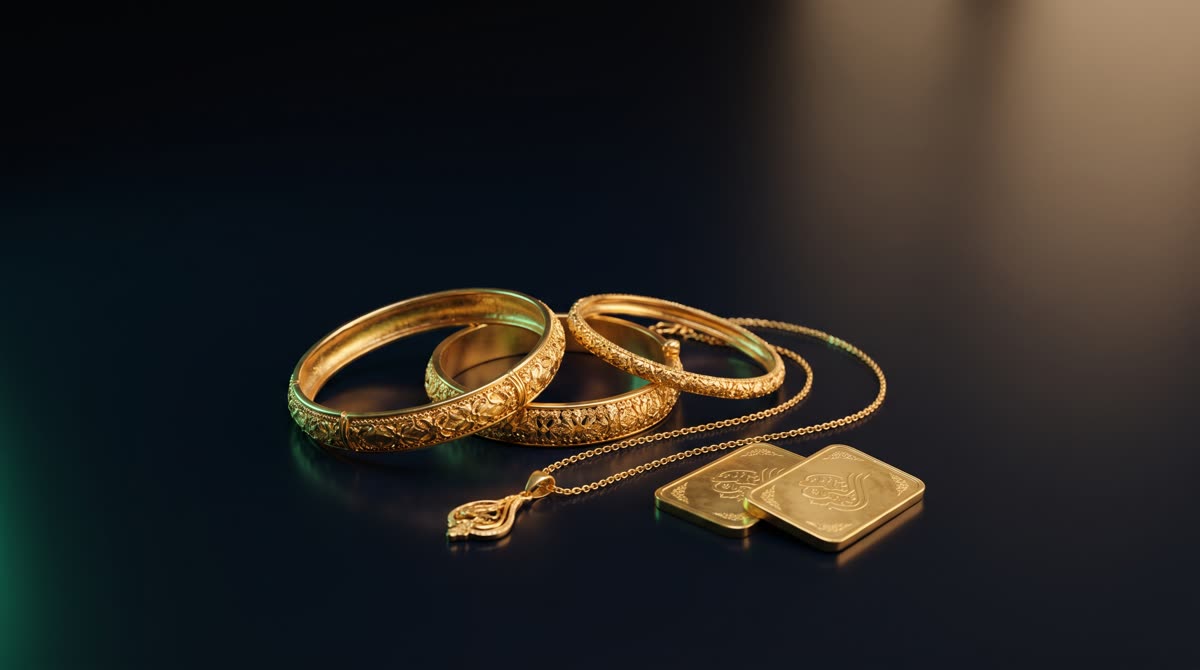
Gold is one of the most common things people own — and one of the most commonly miscalculated when Zakat comes due. Whether it's a wedding set, a few coins you put aside, or bars you've held for years, the question is the same: how much Zakat do I actually owe on this?

This guide walks you through it plainly — the threshold, the rate, what counts, how to handle different karats and jewellery, the gold-vs-silver nisab debate, and a worked example with current 2026 gold prices you can copy with your own numbers.
The short version
You pay 2.5% Zakat on gold you have owned for one full lunar year, once its value reaches the nisab — the minimum threshold set at 85 grams of pure gold (or its equivalent in cash). Weigh your gold, multiply by today's price per gram, and if the total meets or exceeds the nisab, pay 2.5% of the full value — not just the portion above the threshold.
Three numbers to remember:
- 2.5% — the rate (one-fortieth of the value).
- One lunar year (hawl) — the gold must be in your possession for a full Hijri year (~354 days).
- 85 grams — the nisab threshold for gold. Below it, no Zakat is due on the gold alone.
Step 1 — Work out the nisab in money (with 2026 gold prices)
The nisab is a *weight*, but Zakat is paid on *value*. So first convert 85 grams into today's money.
Nisab (in your currency) = 85 × today's price per gram of gold.
Gold prices move daily, so use the current rate. As of late August 2026, gold is trading around $148–149 per gram (about $4,600 per troy ounce). That puts the 85-gram gold nisab at roughly $12,600–$12,700 — meaning if your total zakatable wealth is below that figure, no Zakat is due.
The gold vs silver nisab debate. The nisab can also be measured in silver: 595 grams of silver. Because silver is far cheaper per gram, the silver nisab is much lower — around $1,100–$1,200 in 2026. The majority of scholars follow the gold nisab (the higher, stricter threshold), while the Hanafi school permits following the silver nisab (the lower threshold, which brings more people into Zakat and is seen as more beneficial to the poor). Whichever you follow, be consistent across years.
If your gold is worth less than the nisab *and* you hold no other zakatable wealth, no Zakat is due. If it's worth more — or your gold plus cash and investments combined exceeds the nisab — you pay on the whole amount, not just the portion above the threshold.
Step 2 — Add up the gold you own
List everything made of gold that you own, in whatever form:
- Jewellery — bangles, necklaces, rings, sets (see the note on wearable jewellery below).
- Coins — bullion and collectible gold coins.
- Bars and ingots — investment gold.
- Gold held in accounts — allocated gold savings or gold-backed certificates you effectively own.
Weigh each item in grams. For jewellery, the weight is usually stamped or on the receipt; a jeweller can confirm it in minutes.
Step 3 — Convert weight to value (and handle different karats)
Multiply the total grams by today's price per gram:
Total gold value = total grams × price per gram.
Most jewellery is not 24-karat pure gold. If you want to be precise, calculate on the pure-gold content using this purity table:
| Karat | Purity | Pure-gold fraction | | --- | --- | --- | | 24k | 99.9% | 100% | | 22k | 91.6% | ~91.6% | | 21k | 87.5% | ~87.5% | | 18k | 75.0% | 75.0% | | 14k | 58.3% | ~58.3% | | 9k | 37.5% | 37.5% |
So a 100-gram 22k set contains about 91.6 grams of pure gold; value it at 91.6 × today's price per gram. Many people, for simplicity and caution, pay on the full market value of the piece (which already reflects its purity) — that is the more cautious option and is widely accepted.
Step 4 — Apply 2.5%
If the value meets or exceeds the nisab and you've owned the gold for a lunar year:
Zakat due = total gold value × 0.025.
A worked example with 2026 prices
Suppose you own:
- A 22k jewellery set weighing 100 g
- Gold coins weighing 20 g
That's 120 g total. At $148/g, the market value is 120 × $148 = $17,760. That's above the nisab (~$12,600), and you've had it over a year — so Zakat is due:
$17,760 × 2.5% = $444.
You'd pay $444.
If you wanted to calculate on pure-gold content instead: the 22k set contributes ~91.6 g pure, the coins (assume 24k) contribute 20 g, so ~111.6 g pure × $148 = $16,517 × 2.5% = $413. Either method is defensible; pick one and apply it consistently.
Jewellery for wearing vs jewellery for saving
This is the most common question. The majority scholarly view is that gold owned above the nisab for a lunar year is zakatable including jewellery, whether you wear it or store it. Some scholars exempt jewellery kept for personal daily use rather than storage of wealth, but this is a minority position and the exemption is narrow.
The practical guidance most families follow:
- Investment gold (bars, coins, unworn sets kept to store value) — always zakatable, no disagreement.
- Everyday jewellery worn regularly — the majority say zakatable at 2.5% on its value; pay to be safe, or consult a scholar you trust for your specific situation.
- Gold you've given away (a daughter's wedding set that has left your possession) — no longer yours, so not your Zakat to pay.
Combine with the rest of your wealth
Gold is rarely the whole picture. Zakat also applies to cash, savings, investments, rental income and business assets — and the nisab is judged against your total zakatable wealth, not each category in isolation. A person with $8,000 of gold and $6,000 of savings has $14,000 of zakatable wealth — above the ~$12,600 nisab — and owes 2.5% on the combined total, even though the gold alone was under the threshold. This is why combining matters: it catches wealth that hiding in separate categories would miss.
For the full walkthrough across every asset class, see the complete Zakat calculator guide, or use the live Zakat Calculator tool.
The mistakes that cost people
- Using a stale gold price. The nisab and your Zakat both track the live gold price. With gold near $148/g in 2026, a price from even a year ago understates what you owe. Recalculate each year.
- Paying only on the amount above the nisab. Zakat is due on the entire value once you cross the threshold, not the excess.
- Forgetting the lunar year. The count is by the Hijri calendar (~354 days), not the Gregorian year. Many people fix a single Zakat date each Ramadan to keep it simple.
- Mixing gold and other wealth incorrectly. Combine all zakatable wealth and check the total against the nisab — separate categories can each look under the threshold while the combined total is over it.
- Valuing 22k as 24k. If you calculate on pure-gold content, apply the purity fraction; if you pay on market value, the karat is already reflected in the price.
What about gold you owe money on?
If you bought gold on instalments and still owe a balance, you deduct the immediately due instalment (the payment due within the next twelve months) as a short-term debt, the same as for any zakatable asset. You do not deduct the entire remaining loan — only what is payable now. If the gold's value minus that immediate debt still exceeds the nisab (combined with your other wealth), pay 2.5% on the net.
The short checklist
- Weigh every piece of gold in grams.
- Value each at today's price per gram (adjust for karat if you calculate on pure content).
- Add cash, savings, investments and other zakatable wealth.
- Subtract only immediate short-term debts.
- If the net is above the nisab (~$12,600 by the 85g gold standard in late 2026), pay 2.5%.
That's exactly why WiseEnding's My Purpose tracks Zakat on everything you own — gold, cash, property, investments — in one place, so nothing is missed and every intention is fulfilled.